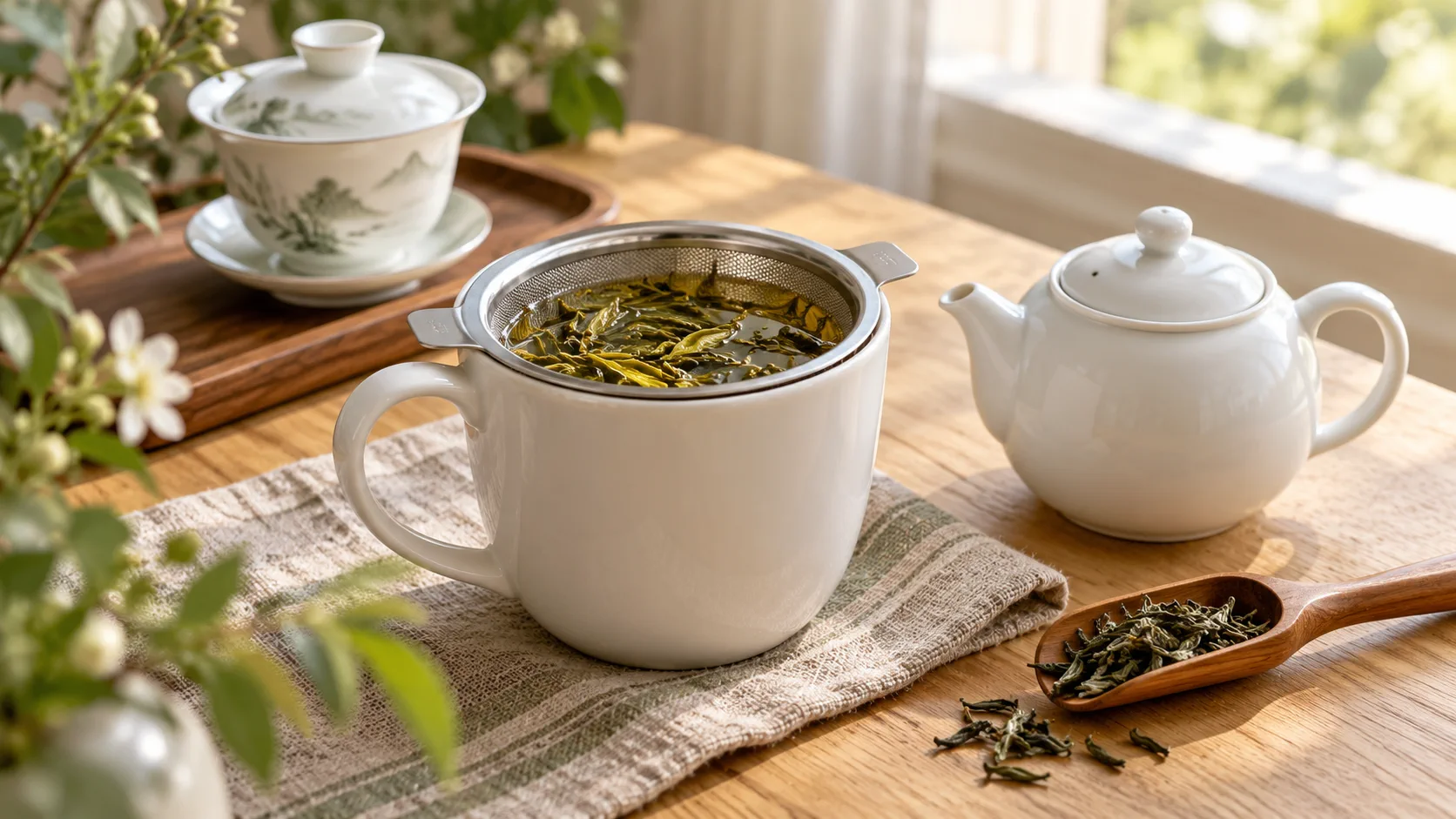
The simplest way to brew tea is to measure your leaves, heat water to a temperature that suits the tea, steep for a set time, then separate the leaves from the liquid. The amount of leaf, water temperature and steeping time work together, so no single recipe suits every tea.
For a first cup, start with about 2 grams of dry leaf for roughly 240 ml (8 fl oz) of water. Use the temperature and time in the chart below as a starting point. Taste the result, then change one thing on the next brew. If your tea came with package instructions, follow those first.
This guide covers tea made from the Camellia sinensis plant, such as green, white, oolong and black tea. Herbal infusions are outside its scope. If you are curious about Chinese loose-leaf tea but only own a mug, a kettle and a strainer, you already have what you need.
What Do You Need to Brew Tea?
You do not need a formal tea set. A practical beginner kit looks like this:
- A mug or teapot. Choose one that holds your water amount comfortably. A teapot lets you pour all the tea off the leaves at once, which makes timing easier.
- A kettle. Any kettle works. One with a temperature setting is convenient for the cooler teas, but it is not essential (see the FAQ below).
- A roomy basket or strainer. Loose leaves swell as they soak, so give them space to open rather than packing them into a tiny tea ball. A large basket that sits inside your mug or pot is a practical option for beginners. You can also leave the leaves loose and strain the tea as you pour.
- A timer. Your phone is fine. Using a timer helps you repeat a steep you enjoyed.
- A scale (helpful, not required). Leaf shapes vary a lot. Two grams of tightly rolled leaf takes up far less space than two grams of fluffy, open leaf, so a spoon is only a rough guide. A scale that can measure small amounts of tea makes it easier to repeat the dose.
- A cup to drink from. If you use a teapot, pour the finished tea into another vessel so it stops steeping.
Use fresh drinking water that tastes pleasant on its own. If your local tap water has a strong flavor, filtered water may help. You do not need special spring water for a good first cup.
A clear glass cup lets you watch the leaves open, which can be especially enjoyable with green tea. A porcelain gaiwan, or lidded bowl, is a versatile alternative for exploring Chinese teas. Neither is a required purchase: a mug or teapot is enough to begin.
How to Brew Tea in Five Simple Steps
Here is how to brew loose leaf tea in a mug or teapot. The key is to separate the leaves when the tea is ready.
Step 1: Measure the leaf and the water
Weigh about 2 grams of dry tea for each 240 ml of water. This is a deliberately light starting dose, rounded from the 2 g per 237 ml recommended by Tea Drunk. Some teas and preferences call for more leaf. Treat the amount as a starting point and follow package instructions when provided. Gongfu uses a different ratio and shorter steeps, as the later example shows.
This tea-to-water ratio gives you a starting answer to “how much tea should I use per cup?” Here, a “cup” means roughly 240 ml, or about 8 US fluid ounces. Mugs vary in size, so use the measured water volume. If your mug is larger or smaller, scale the leaf up or down in the same proportion. Do not assume a teaspoon equals a fixed number of grams; its weight varies with the shape and size of the leaf.
Measure the water too. Knowing how much water you actually use is what lets you repeat a good cup later.
Step 2: Heat the water to suit the tea
Check the chart in the next section. Greener, more delicate teas generally call for cooler water than black or roasted oolong teas. Use a temperature setting or a food thermometer to match the chart. With a basic kettle, boil the water and let it cool for lower-temperature settings. Use water near boiling for the roasted oolong example; the black-tea starting point is slightly cooler, at 95°C / 203°F.
The chart describes the water temperature before pouring, rather than the temperature of the finished infusion. The vessel and leaves affect how quickly it cools.
Step 3: Add the water to the leaves
Put the leaves in the basket or pot, then pour in the water. Pour gently over all the leaves so they are all wet. Start your timer as you begin pouring.
Step 4: Time the steep and taste
Steep for the time in the chart, and treat it as the first time to try, not a rule. If you want to know how long to steep tea, the honest answer is that it depends on the tea, the amount of leaf and your preference. You can take a small spoonful before the timer ends, let it cool enough to sip comfortably, and check the flavor. Longer steeping usually makes tea stronger and often more bitter, so tasting helps you find your own endpoint.
Step 5: Remove the leaves
When the time is up, lift out the basket or pour the tea off the leaves into your cup or a second pot. This step matters. If the leaves stay in the water, the tea keeps steeping, and the time you carefully measured no longer applies. Decanting, meaning pouring all the tea off the leaves, is also a convenient way to stop the brew, as In Pursuit of Tea points out.
If you only have tea bags
Follow the package instructions for the amount of water, temperature and steeping time, then remove the bag. If directions are missing, use the chart as an approximate guide to temperature and time for that tea style; its loose-leaf dose is not a bag-count instruction. Taste and adjust, shortening the next steep if it was harsh.
Green Tea Brewing Demonstration
Watch a Chinese green tea demonstration with Mandarin narration and bilingual subtitles. It shows glass-cup methods that differ from the strain-and-decant method above.
Tea Steeping Time and Temperature Chart
These four examples are light starting points for everyday mug or teapot brewing, often called Western-style brewing. Each tea category contains styles that may need different settings.
| Representative tea/style | Dry leaf / water | Water temperature | First steep to try |
|---|---|---|---|
| Chinese green tea, e.g. Longjing | 2 g / 240 ml | 80°C / 176°F | 2 minutes |
| White tea | 2 g / 240 ml | 85°C / 185°F | 2 minutes |
| Roasted strip oolong, e.g. Wuyi-style tea | 2 g / 240 ml | 99–100°C / 210–212°F | 2 minutes |
| Black tea (Chinese hong cha) | 2 g / 240 ml | 95°C / 203°F | 3 minutes |
How to use the chart
Find the row that is closest to your tea, use the quantities as written, and taste the result. The dose follows Tea Drunk’s recommendation linked above, rounded to 240 ml. Other settings draw on the Tea and Herbal Association of Canada, Mei Leaf and the source guides listed below. The settings combine recommendations from those guides; they are starting points, not results from ChaFable brewing tests.
Keep these differences in mind:
- Different guides disagree. Some sellers brew white tea with hotter water than the chart suggests, and some use hotter water for black tea. The chart gives one reasonable starting point rather than the only answer.
- The oolong row is a specific style. It describes a roasted strip oolong, such as Wuyi-style tea, not every oolong. Oolong is a broad category, and some other styles are brewed differently.
- Match the tea to the nearest row. If your tea falls outside these examples, check the seller’s or producer’s directions instead of forcing it into a row.
- Adjust to taste. If a tea is too strong, shorten the time or use a little less leaf. If it is too light, use a little more leaf or steep slightly longer.
When package directions are unavailable, try the closest example once and change a single variable on the next brew. Keeping the other settings unchanged helps you understand the difference.
Western Brewing vs Gongfu Brewing
Western-style brewing uses relatively little leaf for a larger volume of water, with steeps that typically last minutes. It suits a mug or teapot and offers a straightforward place to start.
Gongfu brewing is a Chinese approach that uses much more leaf for much less water and very short steeps, repeated many times. The brewer pours off each infusion quickly and adjusts the next one. It takes a bit more attention, and it lets you taste how a tea changes from one infusion to the next.
| Western (mug or teapot) | Gongfu | |
|---|---|---|
| Leaf to water | Light: about 2 g per 240 ml | Heavy: far more leaf per ml |
| Steep time | Around 2–3 minutes | Seconds |
| Infusions | One or more; taste to decide | Many short infusions, adjusted as you go |
| Best for | Everyday drinking, simple equipment | Tasting how a tea develops |
Choose the approach that fits your time and interest. A mug suits an everyday cup; a gongfu session lets you pay closer attention to successive infusions. You can begin with either, and a mug is enough for this guide’s main method.
A gongfu example: roasted strip oolong
Here is one worked example, adapted from the Mei Leaf brewing guide, for roasted strip oolong only:
- Leaf: 6 g of dry leaf for each 100 ml of brewing water.
- Water: around 99°C / 210°F.
- First drinking infusion: around 15 seconds.
- Later infusions: lengthen them gradually, to taste.
Here, 100 ml means the water you actually add, not the nominal capacity of the vessel. Keep the dose, water volume and timing together: the mug recipe’s low dose with this short steep would be a different recipe, as would a gongfu dose steeped for several minutes. The vessel alone does not determine the method.
Start the timer as you begin to pour, and decant promptly at the target time. The timer already includes the pour. The leaves remain in contact with water as you drain, so pour and drain consistently and treat the seconds as approximate. Mei Leaf also recommends a brief rinse for this style: wet the leaves and discard that water before the first drinking infusion. That belongs to this particular recipe, rather than every tea preparation. The number of enjoyable infusions depends on the leaf and how you brew it.
How to Fix Common Tea Brewing Problems
Most tea problems have simple fixes. Change one thing at a time, so you can tell what actually made the difference.
Why Is My Tea Bitter?
If your tea tastes unpleasantly bitter, check the time, temperature and amount of leaf. A drying sensation is usually described as astringency; it can accompany bitterness, but describes a different experience. For a harsh cup, these are useful adjustments to try:
- Steeped too long. Shorten the time first. Make small changes relative to the recipe: a short gongfu steep needs a much smaller adjustment than a minutes-long mug steep.
- Water too hot for the tea. Where the tea suits it, use cooler water. Delicate green tea is the usual example.
- Too much leaf. If you used a generous scoop, cut back toward the 2 g per 240 ml starting point.
- Leaves left in the water. If you forgot to remove them, the tea kept steeping after the timer ended. Remove the basket or decant at the end.
Change time or temperature separately so you can compare the result.
Why Does My Tea Taste Weak?
A thin, watery cup usually means too little flavor came out of the leaf. Try a little more leaf first. If that does not help, steep slightly longer, in small steps. Check also that the water is hot enough for that style of tea, before changing several other settings. Remember that a spoon is an imprecise measure. A fluffy, open leaf can look like a big scoop and still weigh very little, so a scale can quickly show whether your dose was low.
What If My Tea Is Too Strong or Lacks Aroma?
If it is overpowering, use less leaf or shorten the steep. If it tastes flat or lacks aroma, check whether the water tastes pleasant and whether its temperature suits the tea. If you used a cramped infuser, try a roomier one so the leaves can open fully. Compare the next cup before changing anything else.
Choose the adjustment that matches what went wrong: a shorter steep for an overly harsh cup, more leaf for a thin one, or a temperature check if the kettle setting was uncertain. Write down what you changed and how the next cup tasted. Keep the other settings unchanged while you compare.
Frequently Asked Questions
How many times can you steep tea?
Many loose-leaf teas can be steeped more than once, but the number depends on the leaf and the method. Gongfu brewing, with its heavy leaf dose, is designed for many short infusions. With a mug or teapot, try further infusions while the leaf still gives a flavor you enjoy. Taste before you extend. Later steeps do not always need to be longer: Tea Drunk’s mug schedule, for example, uses a shorter second infusion. Stop when the flavor fades to something you no longer enjoy.
Do I need to rinse tea leaves?
There is no rinse step in this guide’s everyday mug method. A rinse means wetting the leaves briefly and discarding that water before the first drinking infusion. The Mei Leaf guide recommends one for the oolong example, while other recipes make different choices. Follow tea-specific directions: whether to rinse depends on the tea and recipe, rather than the vessel alone.
Can I brew tea without a scale?
Yes. Use a small spoon, brew once, and adjust. If the tea is too weak, add a little more leaf next time. If it is too strong or bitter, use less. Spoon measures are approximate because leaf shapes differ so much. If you can, weigh your leaf once to see what a spoonful of your tea actually weighs, then use that as your personal guide.
Can I brew tea without a temperature-control kettle?
Yes. A food thermometer is useful if you want to match the chart with a basic kettle. Without one, boil the water, then let it cool for lower-temperature settings. Cooling time varies with the amount of water, kettle and surroundings, so a fixed waiting time cannot reliably give you 80°C or 95°C. Near-boiling water suits the roasted oolong example; the black-tea row specifies 95°C / 203°F. Without a temperature measurement, treat your result as approximate and adjust the next brew to taste.
What is the difference between brewing and steeping?
In everyday use the two words overlap, and many people use them interchangeably. In this guide, brewing means the whole process of preparing tea, from measuring to pouring, and steeping means the soaking of the leaves in water. The practical instruction is the same: watch the leaf quantity, water temperature and time, then separate the leaves when ready.
Your Next Cup
Choose a tea that matches one of the chart’s examples. Follow its package directions if provided; otherwise, try the suggested starting settings. Taste it, then make one change on the next brew: a little more leaf, a slightly shorter steep, or slightly cooler water. Note what changed and what you thought. Use the chart as a reference while you learn which settings you enjoy. A few notes on the amount of leaf, water temperature and time will make a good cup easier to repeat.
Sources
- Tea Drunk, Brewing in a Teapot or Mug
- Tea and Herbal Association of Canada, How to Brew
- Mei Leaf, Tea Brewing Guide (PDF)
- In Pursuit of Tea, How to Make Tea
- Gibbins and Carpenter, Alternative Mechanisms of Astringency — What Is the Role of Saliva? (sensory terminology)