Contents
Before Tea Reaches the Cup
Two bamboo rafts sit at an angle to the current. Baskets cover their decks. The men aboard brace long poles against a river crowded with rocks, their bodies leaning into the work.
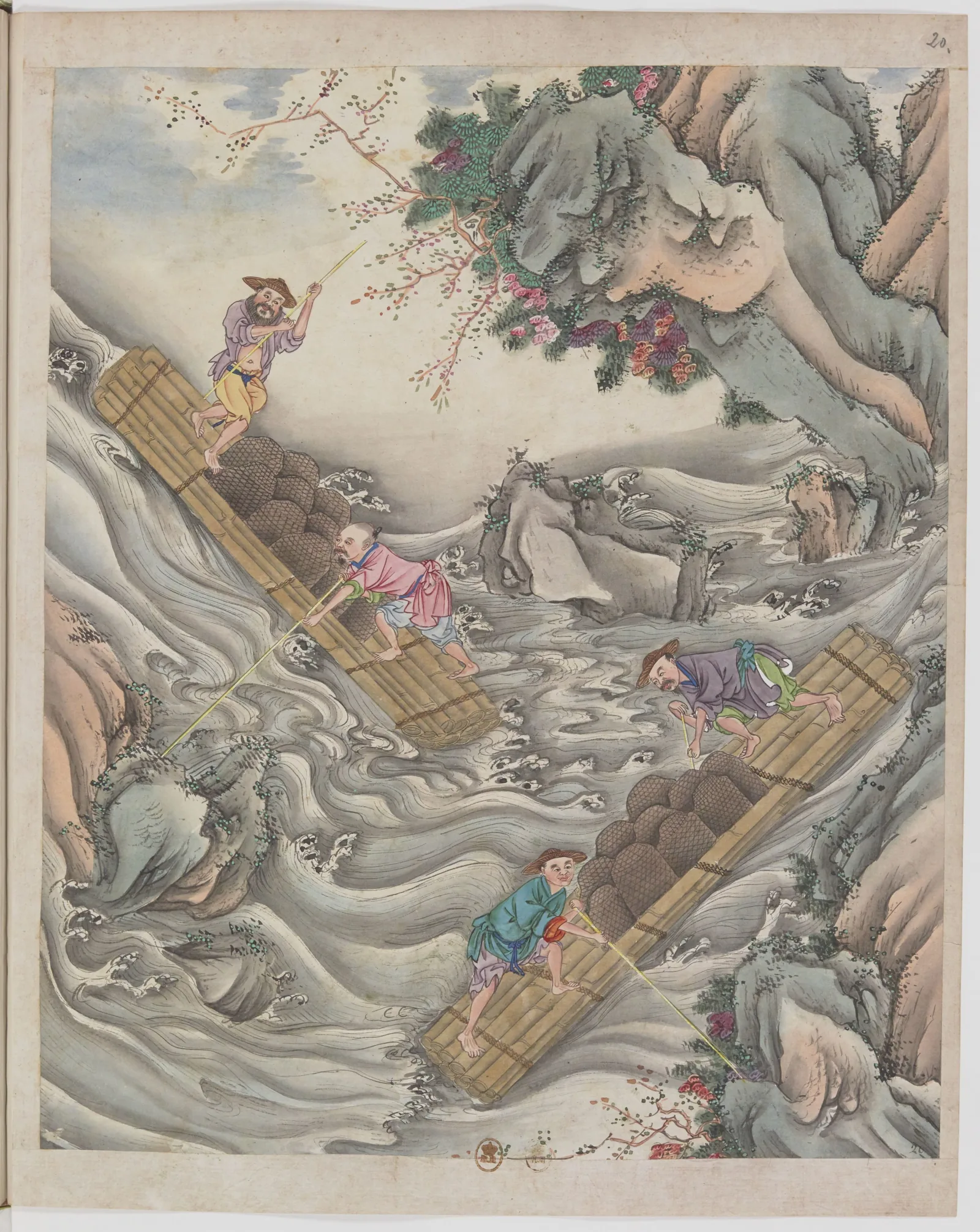
A cup of tea rarely brings this scene to mind. We notice the fragrance, the colour of the liquor, perhaps the shape of the dry leaves. These paintings invite us to look farther back, at the labour of growing, handling, packing and carrying tea. Through ten selected images, we will follow the people, tools and routes behind that work.
How to Read These Paintings
The images come from a thirty-picture digital set supplied to ChaFable through a tea-related educational contact and described as scenes of tea production and trade in Qing China. Its original catalogue, artist, precise date and place of production have not yet been established. We therefore use the original image numbers as references, rather than treating the supplied description as a confirmed museum attribution.
There are documented historical painting series about the Chinese tea industry. The Fitzwilliam Museum, for example, catalogues a separate album associated with Youqua that includes cultivation and processing scenes. These provide useful comparisons, but they do not identify the set shown here.[1]
Our sequence is thematic. It is not a claim that all the pictures portray one batch of tea passing through a single, standard process. Even where the subject looks familiar, an image alone may not settle the plant variety, the operation or the identity of a person watching the work.
The most productive starting point is simpler: look at the tools, hands, containers and paths. What is each person doing? What has to happen before the next task becomes possible?
Working the Land and Gathering Leaves
The work begins with the ground
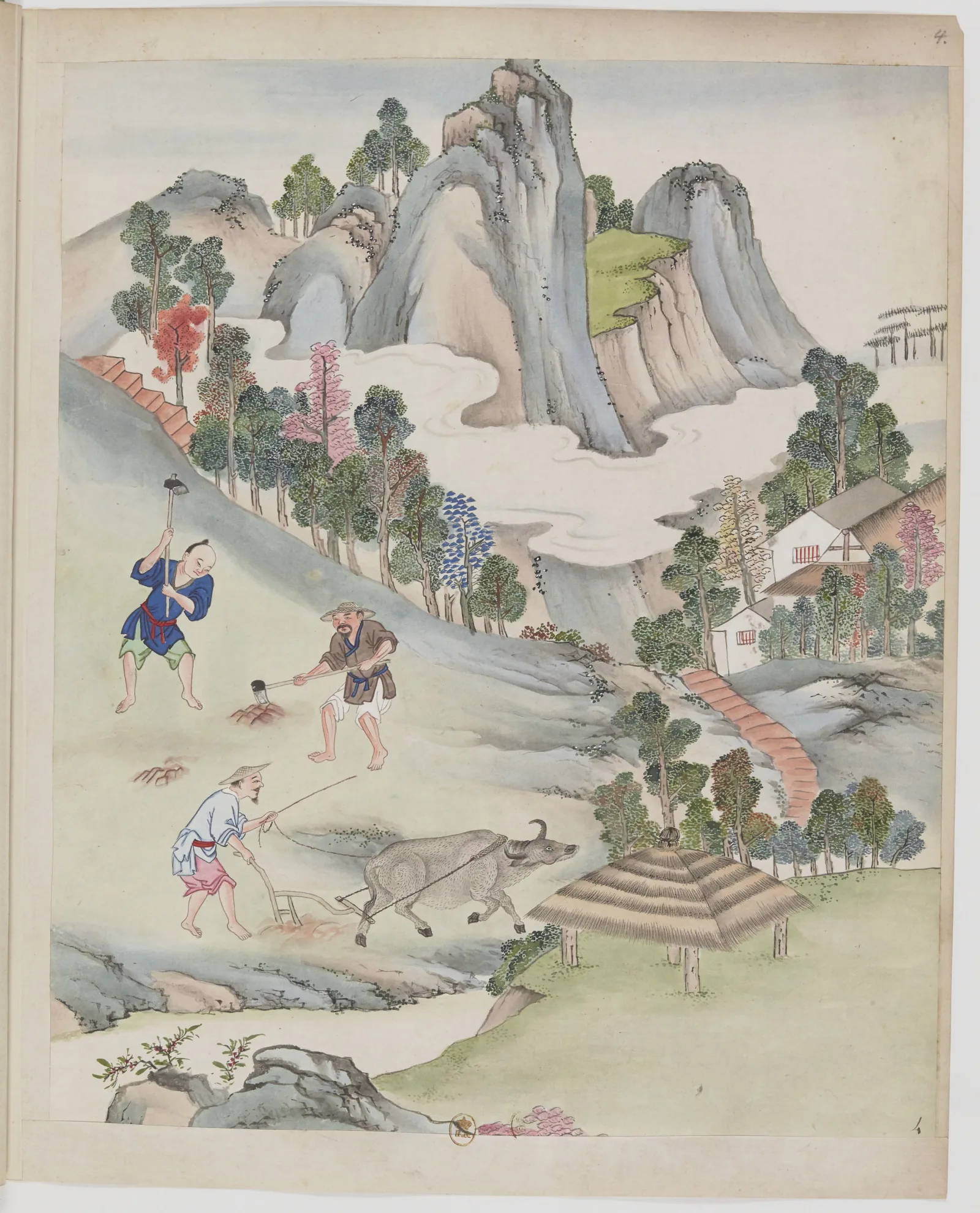
In plate 004, the action is spread across a slope. An ox pulls a plough while other figures raise and lower their hoes. The hillside, paths and nearby buildings occupy much of the composition, yet the small workers give the landscape its practical purpose.
Before discussing what kind of planting the scene represents, notice the combination of animal traction and hand labour. The tools reach different parts of the ground, and the workers occupy different positions. Cultivation appears as a collection of tasks rather than one picturesque gesture.
The crop cannot be identified securely from this view. Within the supplied tea-related set, however, the scene offers a useful place to begin: with the preparation and maintenance of land, rather than the finished leaf.
Baskets connect the plants to the path
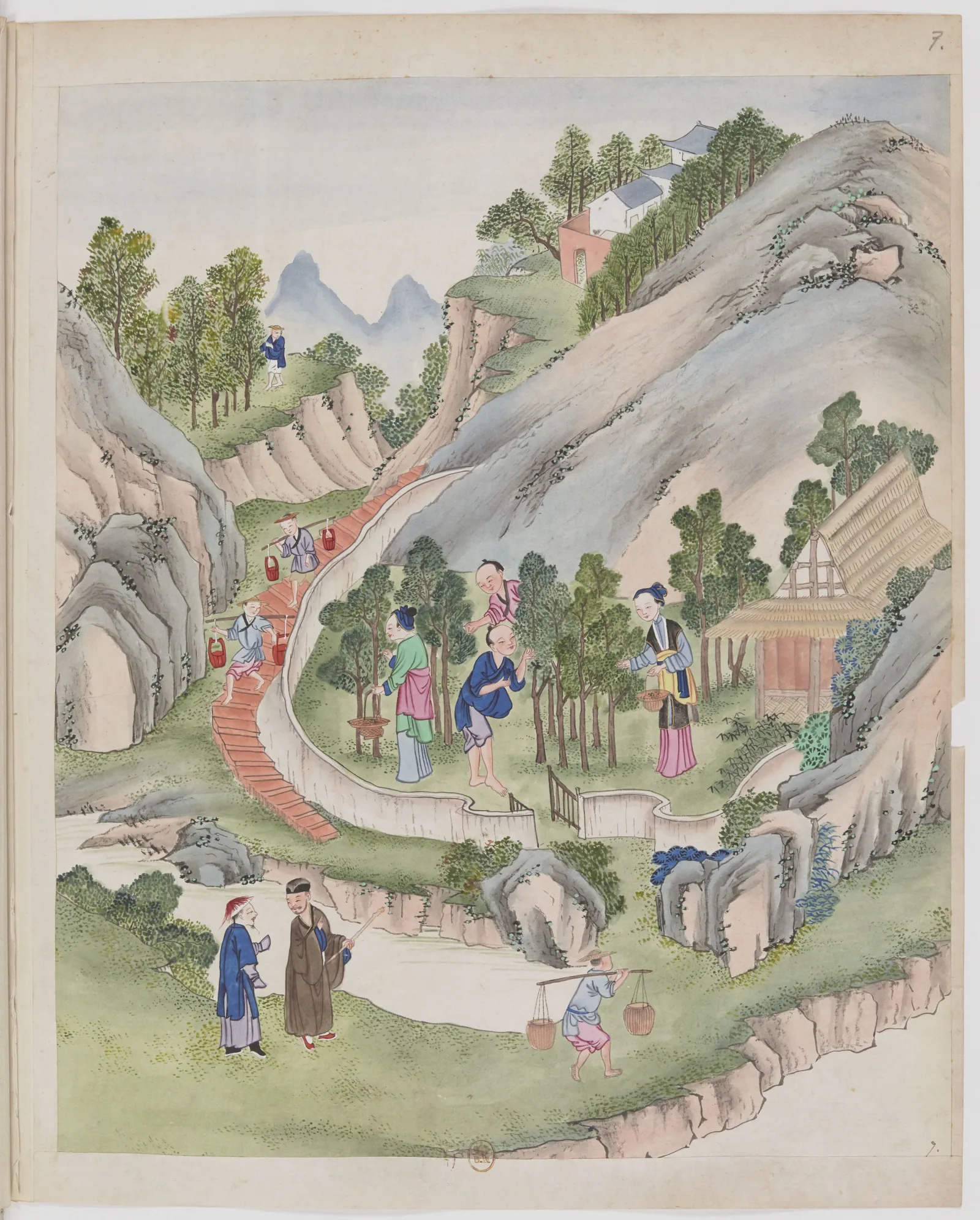
Plate 007 brings us closer to the plants. Figures reach among the foliage; baskets and people moving along a winding route connect this activity to the wider hillside.
Read provisionally as a gathering scene, it shifts attention from individual leaves to their movement. Material collected by hand needs a receptacle. A full basket then needs someone to carry it away. The path is as important to this reading as the plants themselves.
The painting does not show enough botanical detail to establish a tea cultivar or a precise picking standard. Its value here lies in the visible relationship between plants, people, baskets and access through the landscape.
Inside the Processing Workshop
Small movements at a shallow tray
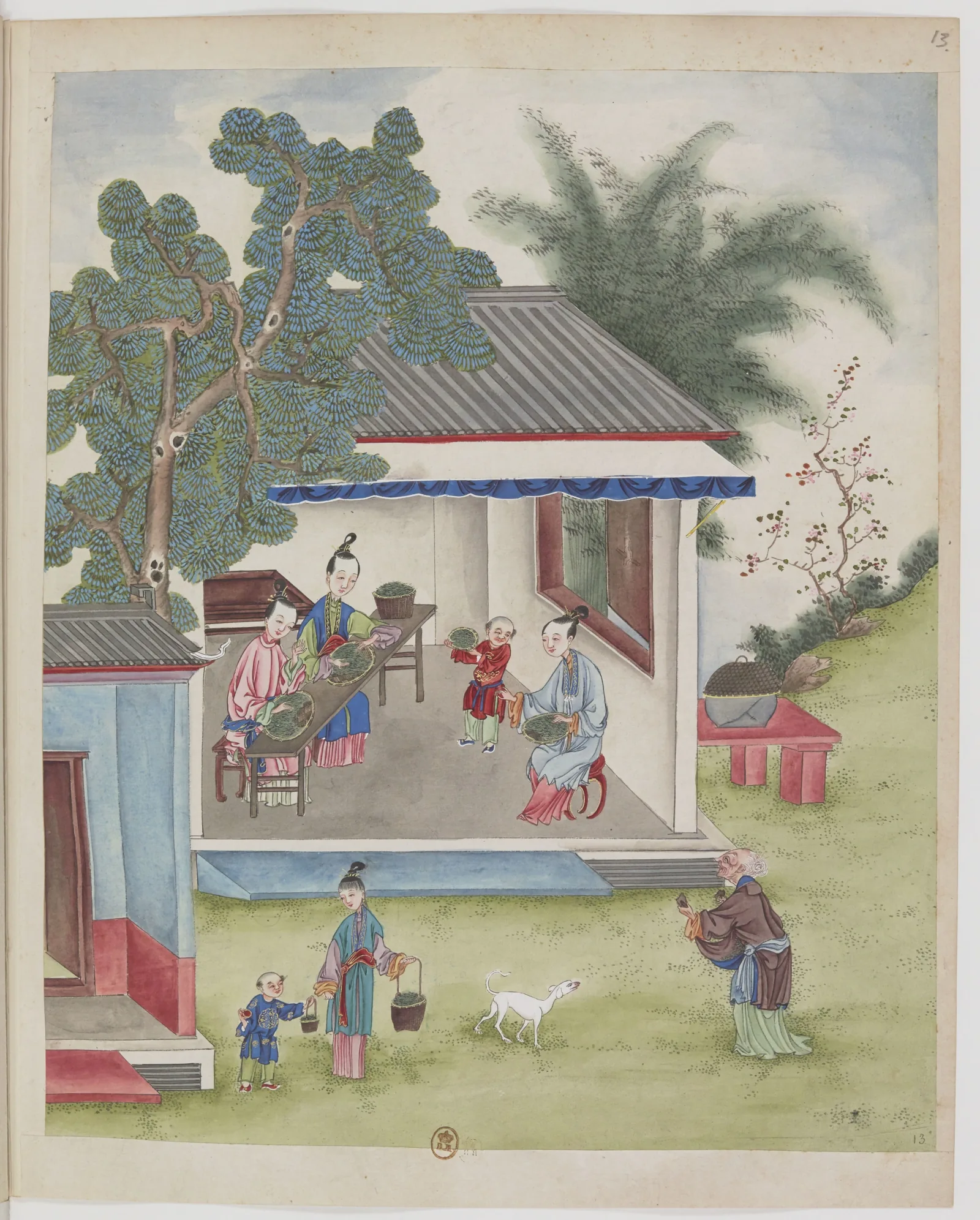
The setting changes from a slope to a sheltered domestic space. In plate 013, seated figures work with material held in shallow trays. The low sides keep the contents visible and within reach, directing our attention to the hands rather than a large machine.
This looks like careful handling and selection. Precisely what is being separated or rearranged is harder to establish. A tray may hold material during more than one operation, so its presence does not by itself distinguish sorting from rolling or another treatment.
There is still plenty to observe. The painting gives this quiet task its own space. Tea-related labour in the album is not confined to energetic digging or heavy carrying; it also includes concentrated work performed close to the body.
Several tasks under one roof
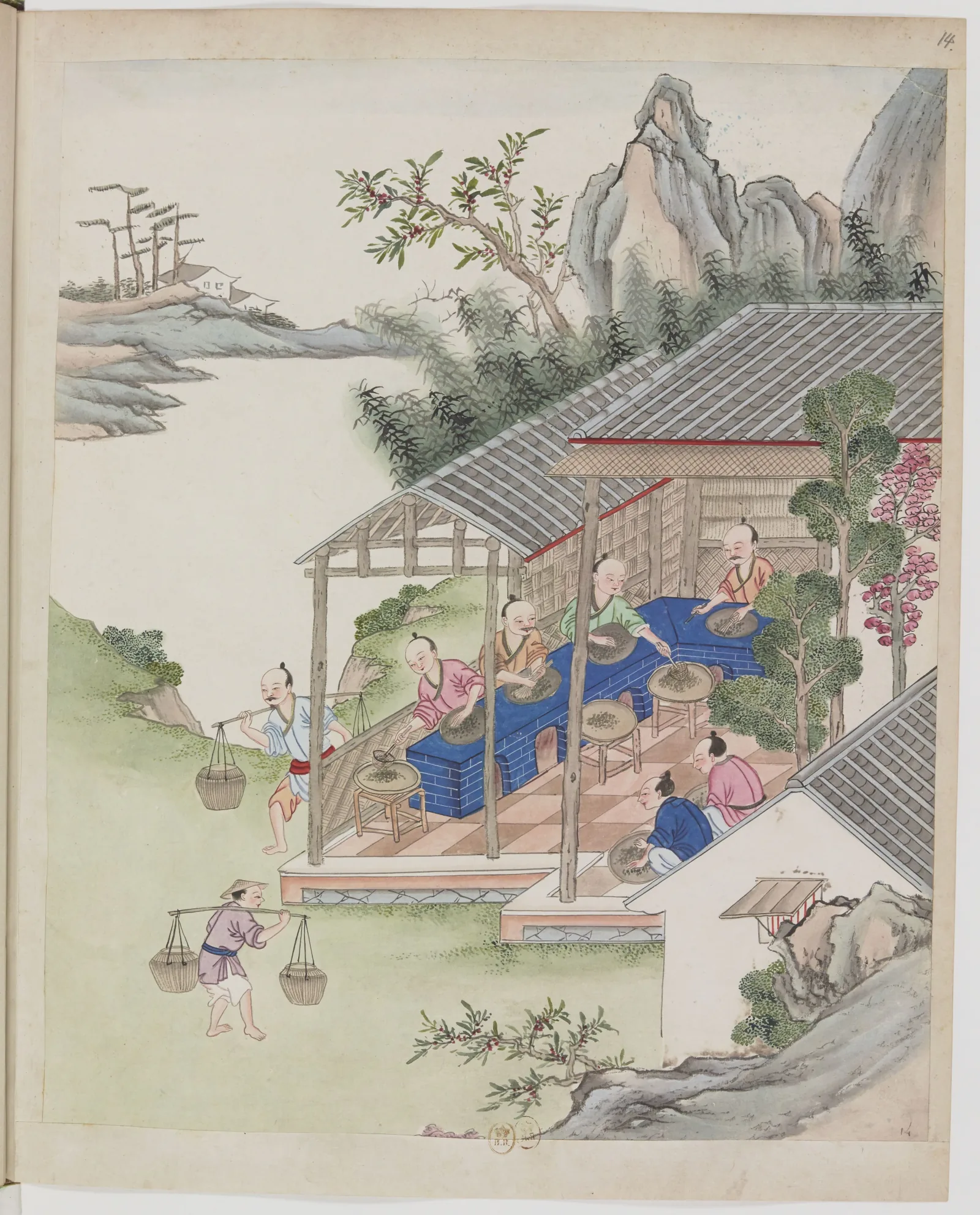
Plate 014 offers a busier arrangement. Workers attend large pans set into raised structures, while others handle woven containers or move loads outside the shelter. Repeated workstations lead the eye across the room.
The contrast with plate 013 is useful. Here the interest is coordination: people at fixed stations, people handling containers, and people moving between the workshop and the outside world. The building is drawn open enough for us to see activities that would otherwise be hidden behind its walls. The repeated workstations and the movement of containers suggest how tasks depended on work happening nearby, making their connections visible within a single scene.
A separate Fitzwilliam collection record explicitly identifies men working at a stove as roasting tea leaves.[2] That comparison helps place pan work within the broader visual history of tea manufacture. It does not establish the exact operation shown in plate 014.
Without a matching caption, it would be premature to label this particular scene fixation, final drying or a stage in making a named tea. What the picture clearly contributes is a view of organised, shared work around equipment.
Weighing and Keeping Records
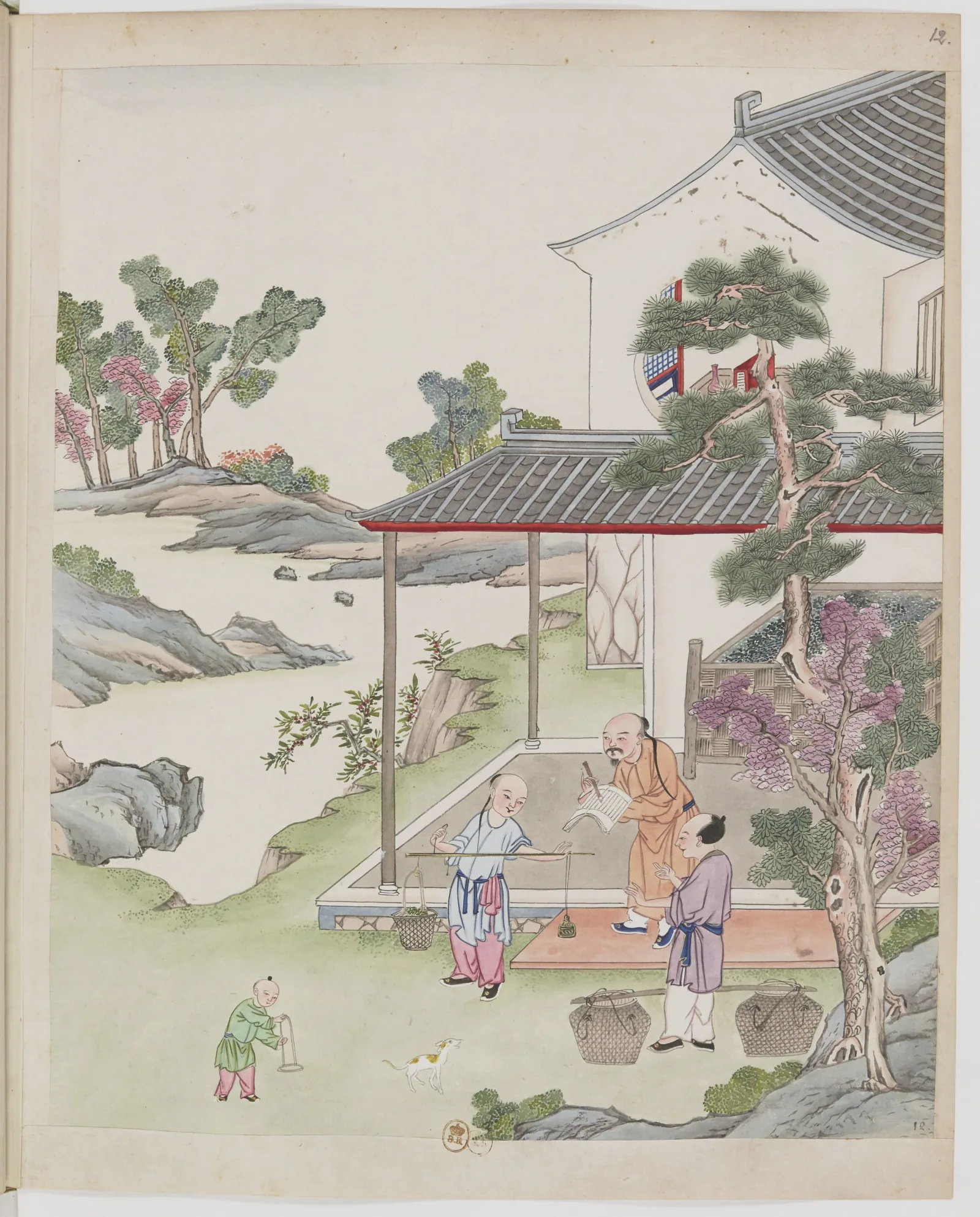
The tools in plate 012 make a different kind of activity visible. One person holds a balance with a basket suspended at one end and a weight at the other. Beside them, another person holds a writing surface and brush. Additional containers wait nearby.
Carrying makes a load move; weighing makes its quantity comparable. Writing can preserve information beyond the immediate exchange. The pairing of the balance and the brush is therefore one of the strongest details in the selected images.
Yet the institutional setting remains open. The picture does not tell us whether the weighing relates to a purchase, a delivery, payment for work or another form of accounting. Clothing alone cannot resolve that question, nor does the presence of a record keeper prove official supervision.
For this visual journey, the important point is the change in attention. Alongside the physical handling of material, we now see measuring and recording it. The working world includes calculation as well as cultivation.
Making Containers and Filling Chests
The container has its own makers
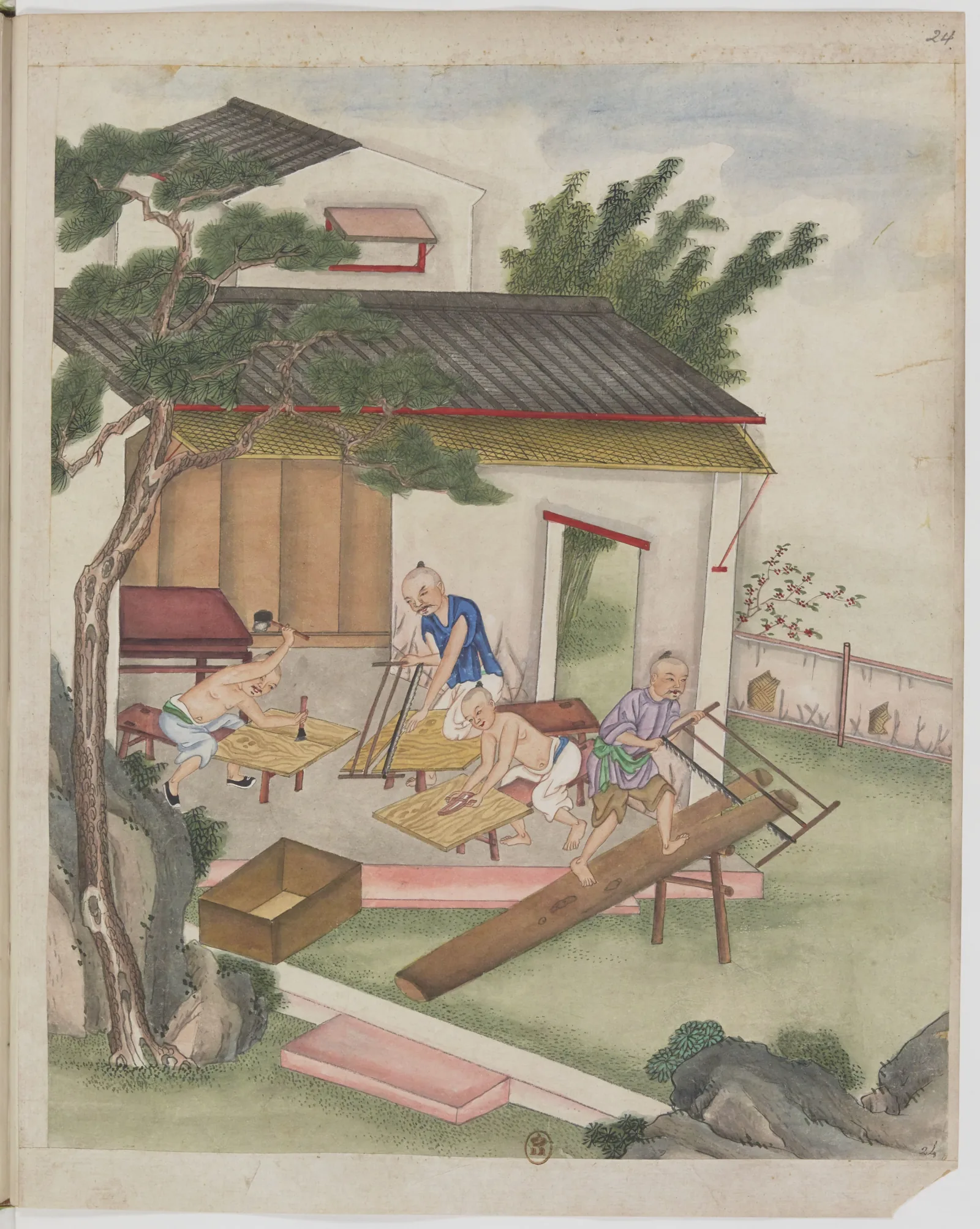
A tea story can easily overlook the carpenter. Plate 024 gives woodworking a prominent place: boards rest on supports, tools meet timber, and an open chest sits nearby.
The image invites us to think of packaging as another product of skilled labour. Before goods can be packed, someone must make a container of a usable shape and size. Sawing, smoothing and assembly belong to that preparation, even though they do not alter the leaves.
Historical tea shipping did use wooden chests. The United States National Park Service describes crates and protective linings used for loose tea, although the surviving examples discussed on its page concern the later nineteenth-century Japanese trade.[3] This is comparative background, not evidence for the date or construction of the chest painted here.
Filling changes the task again
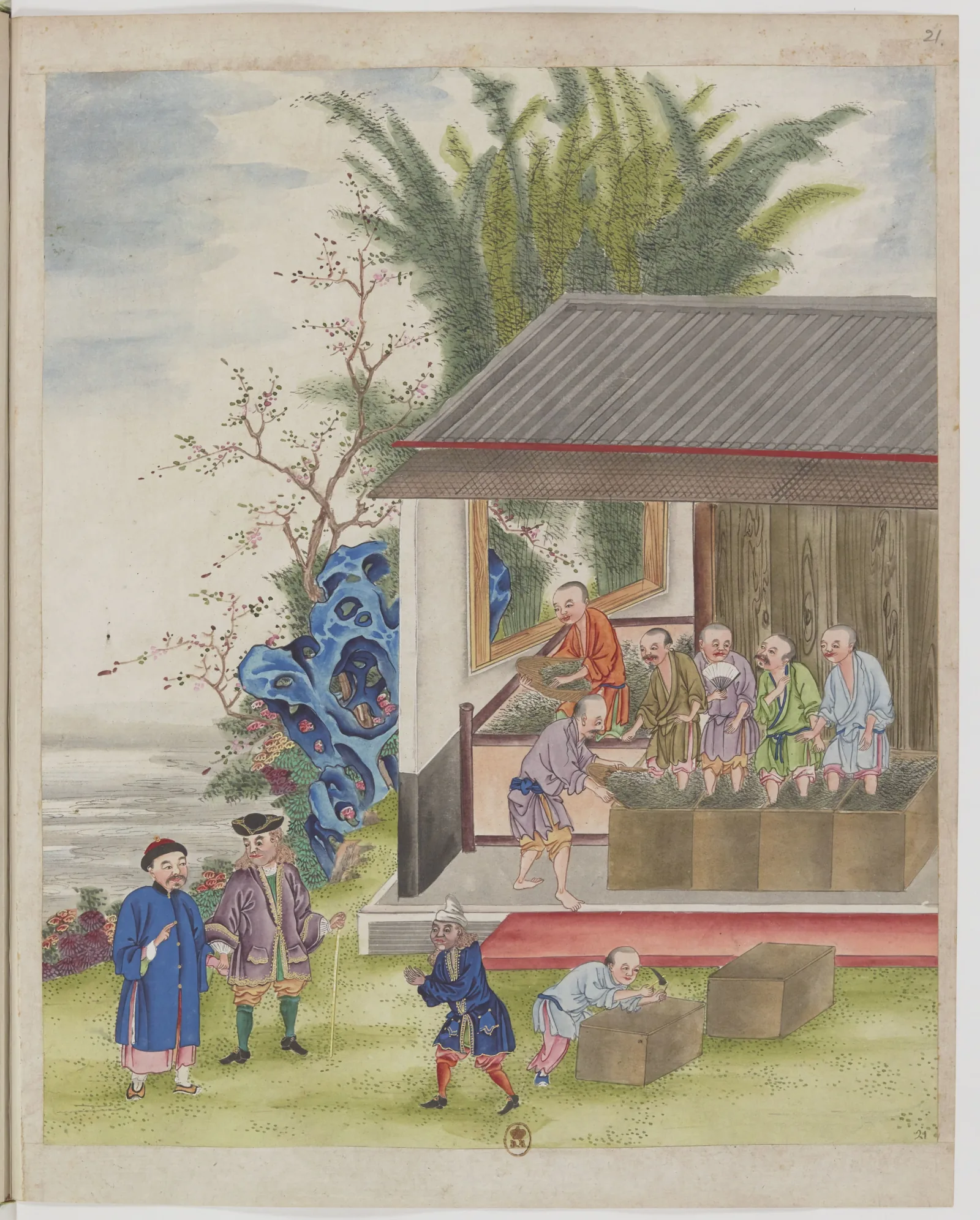
Plate 021 shows shallow baskets being tipped towards large containers. Several figures stand inside the filled boxes; another person works on a chest outside the building.
Their position suggests packing down the contents. The distinction matters: standing in a filled shipping container should not automatically be described as rolling tea, which would assign a manufacturing operation to an apparent packing scene.
The Wellcome Collection holds a separate painting catalogued as workers packing tea into boxes, confirming that packing was also treated as a subject in other tea-related painting series.[4] Again, it is a comparison rather than an identification.
Seen together, the carpenter and the packers make a useful pair. One scene prepares the container; the other brings container and contents together. Packaging labour helps turn loose material into a load that can be carried—a practical link between the workshop and the routes beyond it.
Along Mountain Paths and Waterways
Movement on foot
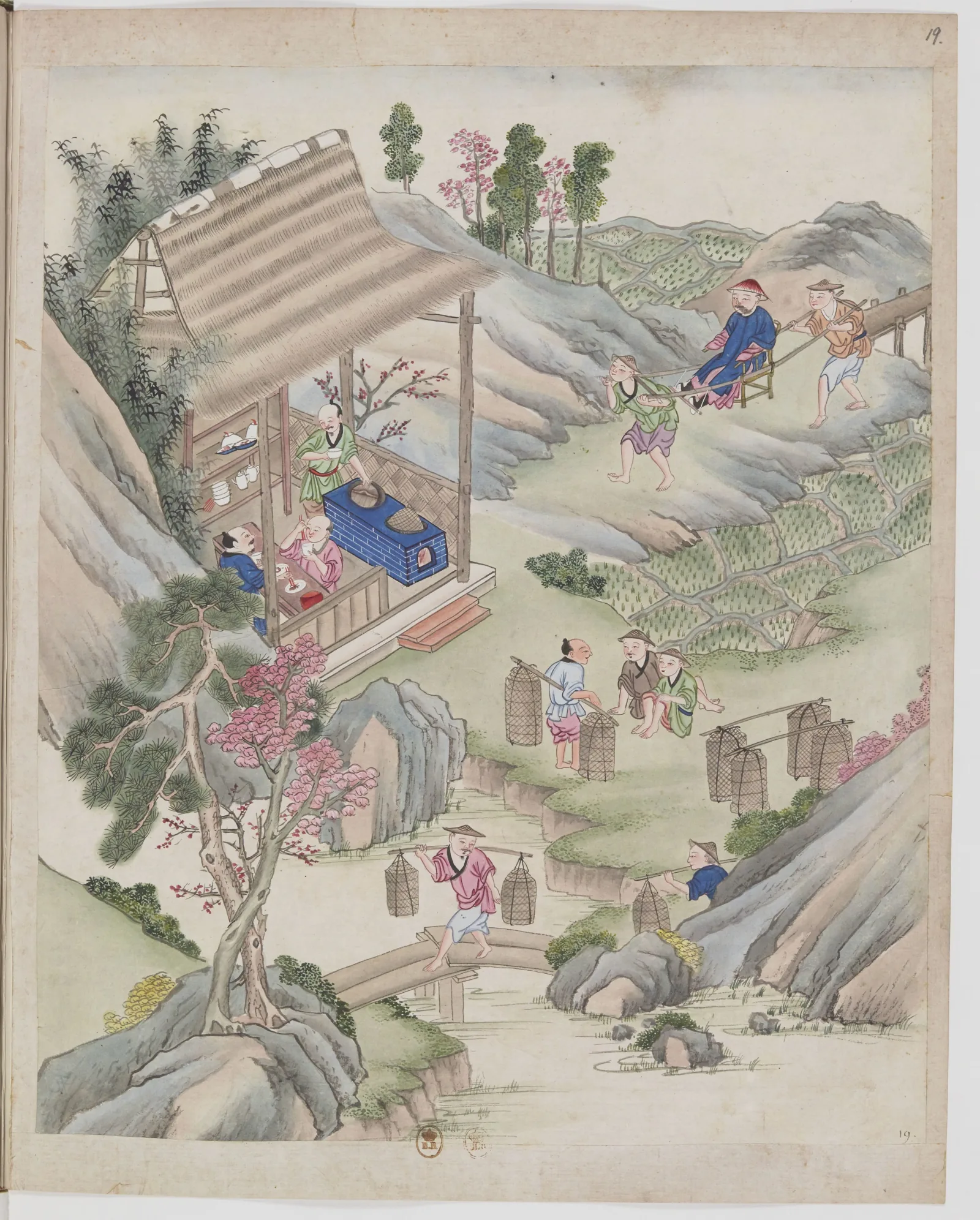
The paths in plate 019 link buildings, slopes and a small crossing. Porters carry suspended loads, while other travellers—including a person carried in a chair—share the route.
Follow the line of movement rather than trying to name every figure. Loads must pass through a landscape with changes of level and limited walking space. The carrying poles, baskets and paths show how closely the means of transport fit the available route.
The image does not identify an official, a merchant or a specific destination. It does make the carriers visible. Their work gives the buildings a connection to places beyond the frame.
Movement by boat
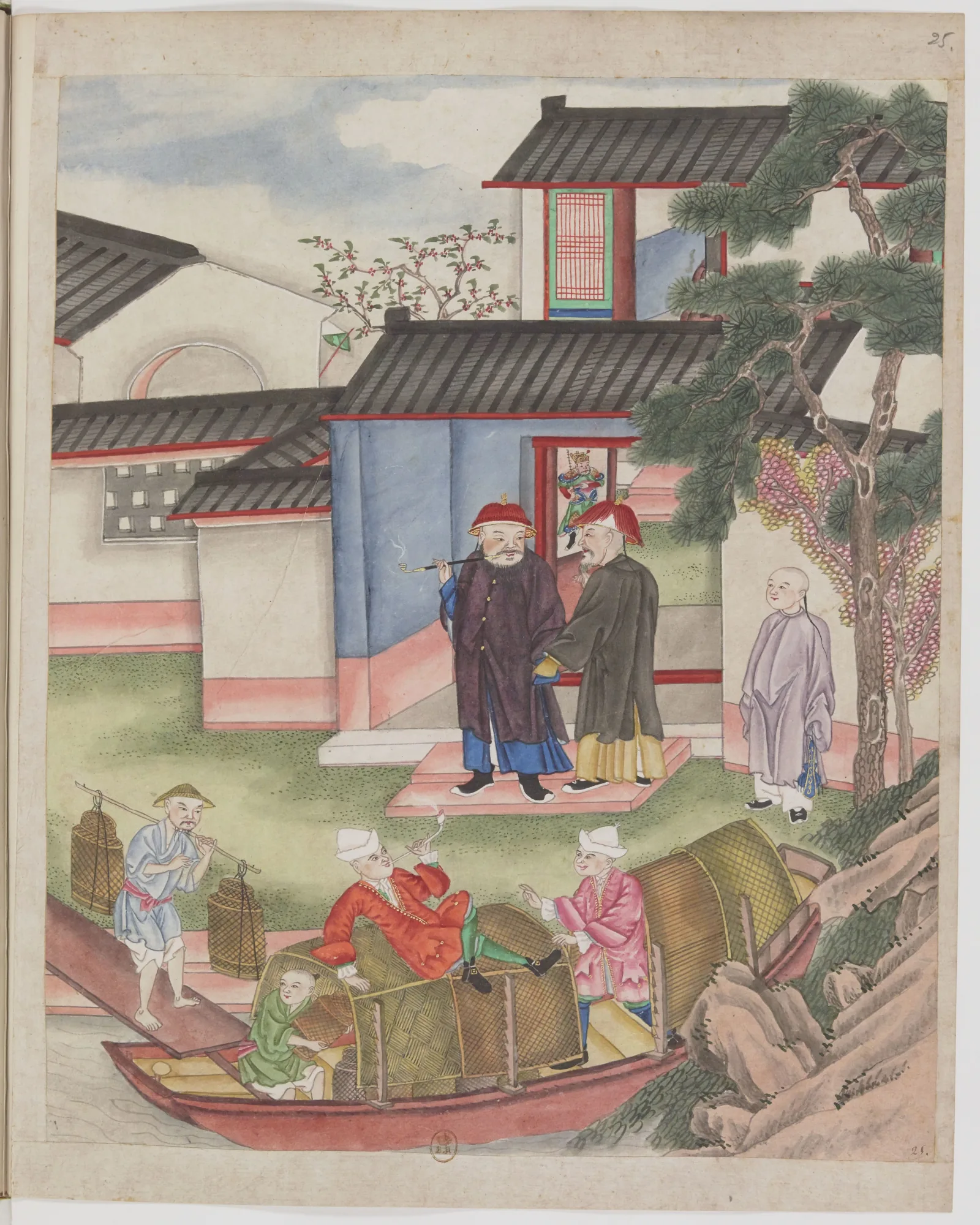
In plate 025, the cargo sits in a boat close to shore. People occupy both the vessel and the landing. The composition gathers travellers, containers and waterside architecture into a compact meeting point.
Compare this with the opening raft scene. The boat at the landing emphasises proximity and gathering; the rafts emphasise the effort of navigating moving water. Together, they offer two views of waterborne movement without requiring us to invent a continuous route between them.
Nothing in these selected scenes establishes that a particular boat was departing for an overseas market. The larger subject of Chinese tea trade includes international connections, but local carrying, river travel and ocean shipping should not be collapsed into one event.
What we can follow is the repeated appearance of loads and the people responsible for them. Containers recur from workshop to pathway to water, tying the article's separate activities together.
What the Paintings Help Us See
These ten pictures offer a way into Chinese tea history through work rather than a sequence of dynasties. A plough, a shallow tray, a balance, a carpenter's board and a boat each draw attention to a different part of the story.
They also leave questions unanswered. We cannot recover wages, schedules, every processing stage or a complete trading route from these scenes. The attractive settings and carefully arranged figures are reasons to look closely, not grounds for treating the paintings as unfiltered records.
Their strongest contribution is the connection they encourage us to notice: growing, handling, measuring, containing and carrying all require people. The next time you look at dry tea before brewing it, there is another question to ask alongside its origin and flavour: how much work made it possible for these leaves to reach the cup?
Sources and Further Reading
These sources provide comparisons and background. None has yet been established as the catalogue entry for the thirty-image set used above.
- The Fitzwilliam Museum: Hoeing the fields, album 4167.
- The Fitzwilliam Museum: Roasting the tea leaves, 4167.11.
- U.S. National Park Service: Tea Chests.
- Wellcome Collection: Workers packing tea into boxes, reference 25248i.
Image source: Digital images supplied to ChaFable through a tea-related higher education institution.